
Making Sense of Beta Testing
For the past couple of months, you’ve probably heard us talk about “beta testing” in relation to the new e-learning training platform we’re developing for senior living professionals. We’ve committed ourselves to building “with and for” the people who matter most by involving senior care providers in our process.
When developing a new service or a physical product, you have to make sure you’re getting it right before you go to market. The term “beta testing” refers to a development process invented in the 1950s and 60s by software companies (think IBM, Apple, etc.). These processes start with “Alpha testing”, or internal testing of a new piece of software to make sure it functionally works, followed by “Beta testing”, which invites outsiders to provide their feedback about the experience of using it. It’s a super “corporate-y” term by all stretches of the imagination, but it’s also the most “human” part of the product design cycle.
For artists, this step is very familiar because we inherently do it when creating generative work. We advance something we’ve made (a painting, a dance, a song, etc.) to a point where we feel comfortable showing it to someone else and then we make a decision to let someone view it, and hopefully to respond and react to it. Beta testing is this same moment in most corporate development processes. Simply put, Beta testing invites feedback.
Feedback is a gift for artists and product developers alike. It’s the most important part of creating something new, because it allows the maker to examine the risk of moving forward. Opening up your product for feedback asks: “Are we putting something out into the world that accomplishes what we hope?” And more importantly, it allows the creator (whether a multi-million-dollar company or a solo artist self-financing the release of a new song or play) to ensure they spend their development dollars and time productively.
Beta testing often occurs in multiple cycles. For Creative Spark, we have just completed our first year of beta testing for our new E-Learning Community. Starting next month, we’ll invite the senior living professionals who helped us in Year 1 to revisit the course materials and training platform we started testing last year. We’re saying: “We heard what you said”, “Did we get it right?” and, “Are the changes we made any better?”
We’re pretty excited about Beta Testing Year 2.0, because we heard a lot of very specific things that we want to get additional feedback about.
Here’s are two examples:
1) One of our testers told us that the content they encountered was wonderful, but they had trouble recalling what they had learned. They remarked that it would have been helpful to have a place to jot down notes. So, we made a workbook, a physical journal that our learners can print out and have beside them while they are taking our course.
2) We’re also addressing the largest piece of feedback, which is that senior leadership and supervisors needed to “co-learn” with their staff. So, we’ve developed a few new tools to support supervisors throughout the process.
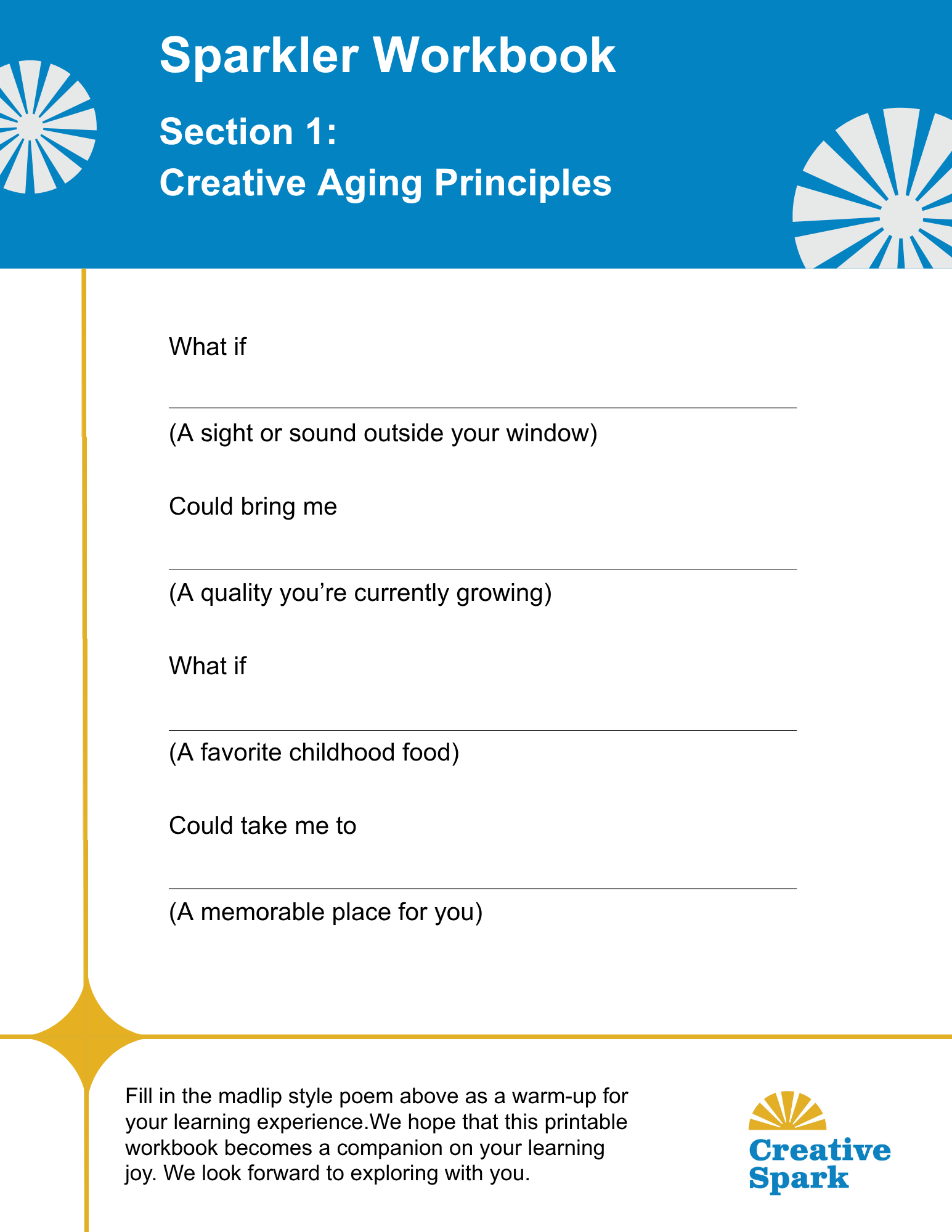
A cover page for our Sparkler Notebook with interactive poetry elements
So what happens after our beta testing period is complete?
If you look at the corporate software development, beta testing is often followed by “gamma testing” and closed-release “pilot periods” leading up to a “public launch”. All of this boils down to one thing: the next step is to put the product (or service) into the hands of more and more people, leading to a moment when it makes sense to make the software available to the general public.
We’ll be doing this with an “Early Access” period for our E-Learning community. Starting in June 2026, we’ll invite approximately 100 industry leaders to explore our platform before it opens to the public. This period will allow us to determine how much additional staff support is needed to support a virtual online community at scale and look for final bugs and glitches. This Early Access period will lead the way to a full public launch, currently planned for 2027.
“Beta testing” is just one jargony phrase in a sequence of corporate nomenclature for doing something that is ultimately very artistic and human. The process of designing a product or service is not unlike what a generative artist undergoes to share their art with the world. In artistic terms, beta testing is the “the gestural study” and “staged reading” that precede works of greatness. It is the moment of turning to someone for the first time and asking “hey, what do you think?” resulting in the confidence to keep going until the beautiful masterpiece is ready to hang on the wall under glass.
What kinds of things have you beta tested in your work? Which parts of the corporate product development jargon resonate with you as an artist, if any?
----
Park Cofield (he/him) is a human-centered community builder, strategy consultant, and social entrepreneur with a specialty in building programs and products with and for older adults. He excels at designing spaces for conversation, interaction, and creative engagement. You can learn more about his work at: www.parkcofield.com