
Responsive Design: Our “With and For” Approach
When I was hired to help with business strategy for Creative Spark, the first thing that struck me was the team’s commitment to a “with and for” approach.
What does this mean exactly? For me, coming from a human-centered design background, this implied that the team wanted to build their new e-learning product in a way that would be directly informed by the people most impacted. In Creative Spark’s case, this means senior living professionals and people working with older adults. By involving people like you, Creative Spark ensures we’re effectively addressing your day-to-day challenges and needs.
This commitment demonstrates both a sound business strategy and an inherently deeper understanding that the best way to build products is to start without assumption so that you don’t invest too much time or resources in creating something that might ultimately be unwanted or misguided. It means asking the people you are building for what they need (i.e. What are your current challenges? What barriers are you experiencing? Do you even WANT a new approach?). It also means thinking together to determine what assets already exist that can be used to help address the problem. We’re talking about things like blank walls in breakrooms, daily tea service, a deep commitment to family, morning check-ins over walkie-talkies, and other “points of contact” to scale, leverage, uplift or, as the team likes to say, “enchant”.
If we take a step back and break it down, there are five essential components of a human-centered process:
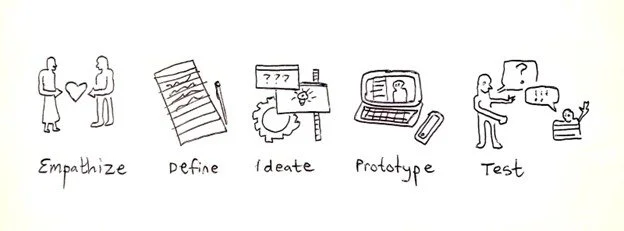
Empathize, Define, Ideate, Prototype, and Test.
First, you listen deeply to identify challenges beneath the surface. Second, you begin to clearly and concisely name the most pressing needs and wants. Third, you begin developing ideas to address these concerns that can meet people where they are. Fourth, you begin to create tangible products (training workshops, physical products, service plans, etc.) that address the challenges you have heard. And finally, you bring those ideas to the people you are co-building with to try out and to see what works (and what doesn’t).
It’s an iterative, reactive process that starts over the second it ends, prompting multiple cycles of these five steps, sometimes in order and sometimes out of order. It’s a process to hone your ideas and find solutions that accurately and clearly address the stated problem through collaboration and co-creation, resulting in a sense of ownership and agency where the “user” is equally important as the designer.
Intuitively, the Creative Spark team (Jessica McCracken and Veronicah Cohen) have been employing a human-centered process for the past 10 years. They’ve been on the ground and in the room with senior living professionals of all kinds, designing workshops, facilitating training, observing the day-to-day challenges of the industry, and most importantly, listening deeply to unspoken needs. They are really good at listening with their hearts instead of just their ears. Their collective work has yielded a range of training solutions and has revealed a clear challenge: Many senior living professionals (CNAs, RNs, Activity Directors, etc.) know their purpose at work but need additional nourishment to keep their spark going amid industry-wide workplace challenges (i.e., burnout, turnover, isolation).
Now, with a clear vision for an industry-changing culture shift in senior training, based on hundreds of successful in-person tests of their methodologies, they are in the midst of building and prototyping a digital solution to bring their work to thousands of people across the country through the Creative Spark E-Learning Community, a virtual platform for training and co-learning.
As of the publication of this blog post, we have recently concluded a beta test of Explore Academy, our most popular product, with five sites participating in a learn-at-your-own-pace version of the training. In January, we will host focus groups with our beta-test learners to directly solicit their input and invite them to provide feedback that will inform the next version of the product and ultimately help refine our business model for the public launch in 2028.
As we listen and observe, one thing has become very clear. There is an isolation problem in senior living — not between staff and residents, but among staff. There is a growing challenge for administrators to develop and nurture connections between team members. This is an epiphany we would likely never have arrived at had we skipped beta testing with real potential learners and jumped forward to building and selling an untested “solution”. We’ve learned that training itself is a “point of contact” for enchanting and building deep connection and engagement among staff. This new clarity will help us refine our curriculum, reconsider how we bring our services to market, and provide new pathways to explore in our next round of beta testing in 2026.
Human-centered work takes time and patience, but, strategically, it is essential for ensuring we use our resources effectively and for mirroring our values as creatives. Creative Spark’s “with and for” approach ensures that underrepresented voices are included as collaborators, fostering a sense of co-ownership and agency. By asking (instead of telling) our customers what they want, we are living our value of equity.
We hope you’ll follow along with us as we continue to listen, define, ideate, prototype, and test in the year ahead. If you’d like to join us as a beta tester, please let us know — we’d love to have you! E-mail us at creativespark@frontporch.net.
Park Cofield (he/him) is a human-centered community builder, strategy consultant, and social entrepreneur with a specialty in building programs and products with and for older adults. He excels at designing spaces for conversation, interaction, and creative engagement. You can learn more about his work at: www.parkcofield.com