
Virtual Community Learning
How a 3-Question Needs Assessment Helped Our Brand New Team Choose an LMS
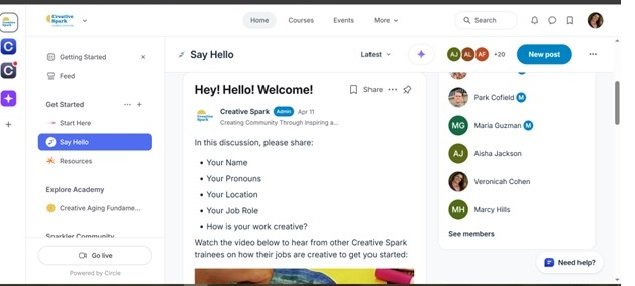
Sneak peak of the Creative Spark Community on Circle with courses, discussion boards and creative aging resources.
When our Explore Academy team first sat down to choose a learning management system (LMS), we were brand new. We were still learning each other’s schedules, communication styles, and superpowers while making a decision that would define the entire learning experience for senior living teams. No pressure, right?
An LMS is simply the online “home base” where learners access courses, track progress, and stay connected to learning. But once you start researching options, the choices multiply fast. Every platform promises to be flexible, intuitive, and “perfect” for your needs. Without a clear focus, the evaluation period can become paralyzing.
That’s why, at the top of my needs assessment, I always start with three grounding details:
Timeline – When do we realistically need this to launch?
Budget – What are we truly able to invest?
Scope – What must live inside the LMS, and what can live somewhere else?
These questions sound simple, but they immediately clarify the decision-making process. They became our anchor as we moved into conversations with the full team.
A Brand-New Team, One Big Decision
I recently completed a second round of edits for the Explore Academy course series, and I’m proud of the LMS we chose. I’m genuinely impressed with how easily the Explore Academy content has translated to the Circle LMS.
Our LMS team included project leads Jessica McCracken and Veronicah Cohen, graphic designer Sarah McKinney, web designer Erin Chmelik, and me, an instructional designer with LMS experience. We scheduled just two to three focused needs assessment meetings, with everyone present.
Jessica and Veronicah brought deep knowledge of Explore Academy’s programming and training goals. They understood the intended audience–senior living staff. How often will they have opportunities to use the LMS? How does the training support creative engagement? Are discussions more important than interactive design elements (e.g. drag-and-drop or matching items)?
Their clarity helped us narrow platform options based on our firm timeline and realistic budget. Instead of evaluating 15 platforms, we focused on just two or three strong contenders.
From there, Erin helped refine the scope. She suggested that some features we initially labeled as “LMS requirements” could actually live on the Explore Academy website instead—informational pages, storytelling elements, or broad messaging. That shift took pressure off the LMS. It didn’t need to do everything; it just needed to do the right things well.
Meanwhile, Sarah was thinking visually. She imagined how illustration, layout, and gentle visual cues could create a calm, welcoming environment for senior living professionals logging in. Her perspective kept us focused on the lived experience of the learner, not just the admin features.
I brought an early LMS landing page prototype to our sessions. Importantly, it wasn’t tied to any specific platform, which helped us avoid bias. We could all look at the mockup and ask: “Does this feel like Explore Academy? Is this an inviting space for staff to learn, reflect, and experiment creatively?”
The Power of Meditations
One element surfaced again and again: the meditations featured in Explore Academy. Check out an example here: The Sunflower Within
We realized they weren’t just an extra feature—they were unique to Explore Academy’s identity. As someone who has practiced meditation and mindful exercises for nearly a decade, I know how powerful these practices can be. Meditation has helped me solve problems more creatively, examine my thoughts with curiosity, and manage my emotions during challenging times.
For staff and older adults alike, this kind of reflective space offers a gentle pause and an invitation to listen inward. Once we recognized how central the meditations were, our evaluation questions changed. We began asking:
Can this LMS support audio or video meditations in a way that feels authentic to the live experience?
Is it easy to revisit content, pause, and move at one’s own pace?
Does the platform’s structure encourage reflection, not just completion?
In other words, instead of asking, “Which LMS has the longest feature list and the most ‘bang for our buck’?” we asked, “Which LMS best supports this unique, reflective experience for staff who are facing burnout and other challenges?”
A Simple Takeaway
If you’re choosing a platform or tool for your own organization, start with those three simple anchors: timeline, budget, and scope. Then, try a quick round of “creativity-spotting” with your team:
Where are you already writing creatively (emails, scripts, lesson copy)?
Where are you visualizing ideas (slides, graphics, page layouts)?
Where are you speaking or facilitating in creative ways (leading groups, coaching, storytelling)?
You may discover that your organization is more creative than you think—and that insight can guide you toward tools and systems that truly reflect your mission and the people you serve. This has been a very fulfilling project to support, and I’ve had a great time working with the team. The team came together easily because we all shared similar values: service, creativity, and unity. I look forward to another year with this team, and am excited to see Explore Academy reach the masses!
Maria Guzman is an instruction design consultant and loves finding creative ways to build high-quality training and courses. She has a background in higher education and the arts. Learn more about her on her website, www.mariaguzman.net.